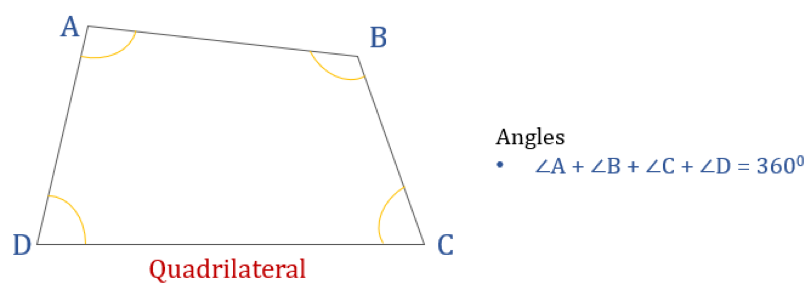
Quadrilaterals can be defined as types of polygons that have four sides, four vertices, and four angles, along with a pair of diagonals. The Sum of interior angles of quadrilaterals is 360°. There are various kinds of quadrilaterals; the quadrilateral shapes themselves explain what type of quadrilateral it is. As the name itself suggest, the word is a combination of two Latin words ‘Quadri‘ means a variant of four, and ‘latus‘ means side.
Quadrilateral Definition
A quadrilateral is defined as a polygon having 4 sides, 4 angles, and 4 vertices. The quadrilateral is a type of polygon in which the sides are defined in a proper pattern. For example, in the diagram below, the quadrilateral can be defined as ABCD, ADCB, BCDA, CDAB, etc. It cannot be defined as ACBD or BDAC. Here, the quadrilateral’s sides are AB, BC, CD, and DA, and the diagonals are AC and BD.
Properties of Quadrilateral
Quadrilateral has several properties that make it different from a regular polygon. The different types of quadrilaterals have special properties to the quadrilateral. However, the properties of quadrilaterals are all valid for the different types of quadrilaterals. The properties of a quadrilateral are:
A quadrilateral has 4 sides.
A quadrilateral has 4 vertices.
A quadrilateral has 4 angles.
A quadrilateral has 2 diagonals.
The sum of internal angles of a quadrilateral is 360°.
There are different types of quadrilateral, and all the types have different shapes. Quadrilateral shapes explain a lot about their properties; just by looking at the quadrilateral shapes, one can tell the difference and qualities among them.
Types of Quadrilateral
Based on their properties, types of quadrilaterals are subdivided into other groups, and the main subdivision of the quadrilaterals is between convex and concave quadrilaterals. These concave and convex quadrilaterals can be further classified into their subdivision.
Concave Quadrilaterals
Quadrilaterals that have one interior angle greater than 180° and one diagonal lies outside the quadrilateral are called concave quadrilaterals. One of the examples of a concave quadrilateral is a Dart. It is a quadrilateral with bilateral symmetry like a kite, but with a reflex interior angle.
Here, in the image given below, one of the interior angles of the quadrilateral is 210°, which is greater than 180°. Therefore, the quadrilateral is a concave quadrilateral.
Convex Quadrilaterals
Quadrilaterals that have all four interior angles less than 180° are called concave quadrilaterals. There are various types of Convex Quadrilaterals:
Trapezium
Kite
Parallelogram
Rectangle
Rhombus
Square
Trapezium
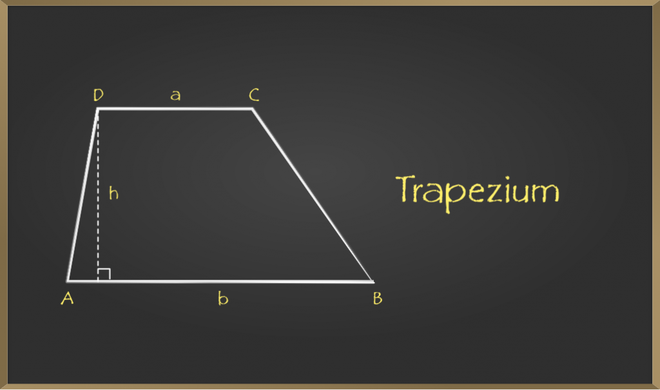
A trapezium is a quadrilateral that has one pair of opposite sides parallel. In a regular trapezium, non-parallel sides are equal, and its base angles are equal. The area of trapezium is 1/2 × Sum of parallel sides × Distance between them.
The sides of the trapezium that are parallel to each other are known as the bases of trapezium. In the above image, AB and CD are the base of the trapezium.
The sides of the trapezium that are non-parallel are called the legs. In the above image, AD and BC are the legs.
Kite
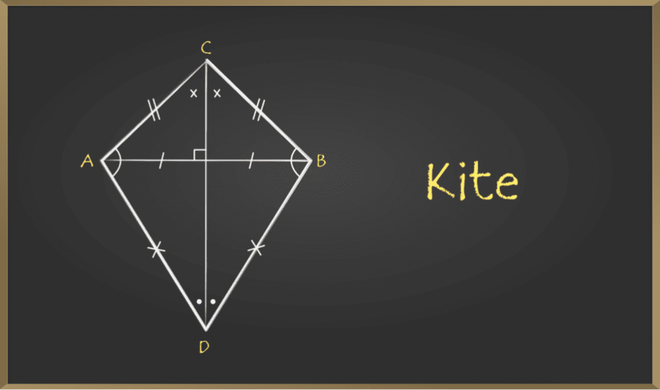
Kite has two pairs of equal adjacent sides and one pair of opposite angles equal. Diagonals of kites intersect perpendicularly. The longest diagonal of the kite bisects the smaller one.
A kite has two pairs of equal adjacent sides. For example, AC = BC and AD = BD.
The interior opposite angles that are obtuse are equal; here, ∠A = ∠B.
The diagonals of a kite are perpendicular to each other; here, AB is perpendicular to CD.
The longer diagonal of the kite bisects the shorter diagonal. Here, CD bisects AB.
Parallelogram
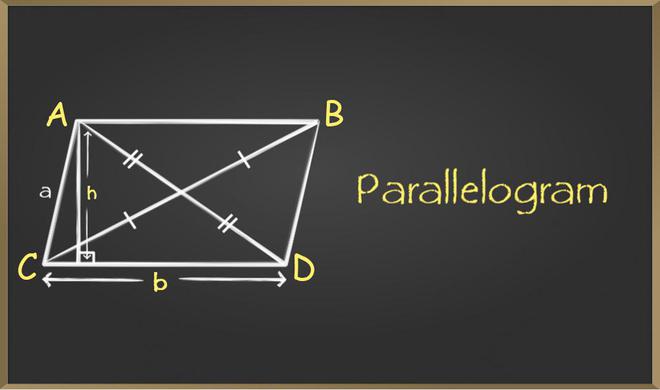
A quadrilateral whose opposite sides are equal and parallel is called a Parallelogram. Opposite angles of a Parallelogram are equal, and its diagonals bisect each other.
The opposite sides of a parallelogram are parallel and equal. In the above example, AB and CD are parallel and equal, and AC and BD are parallel and equal.
The opposite angles in a parallelogram are equal. ∠A = ∠D and ∠B = ∠C.
The diagonals of a parallelogram bisect each other.
Rectangle
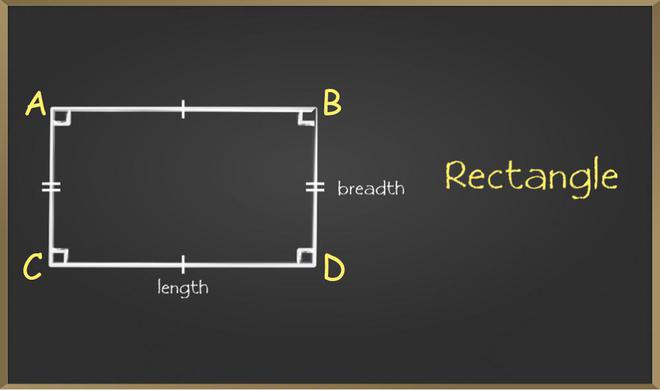
A quadrilateral whose opposite sides are equal and parallel and all the interior angles equal to 90° is defined as Rectangle. Diagonals of rectangles bisect each other. Note that all the rectangles are parallelograms, but the reverse of this is not true. The area of rectangle is length × breadth.
The opposite sides of a rectangle are parallel and equal. In the above example, AB and CD are parallel and equal, and AC and BD are parallel and equal.
All 4 angles of a rectangle are equal and are equal to 90°. ∠A = ∠B = ∠C = ∠D = 90°.
The diagonals of a rectangle bisect each other and the diagonals of a rectangle are equal, here, AD = BC.
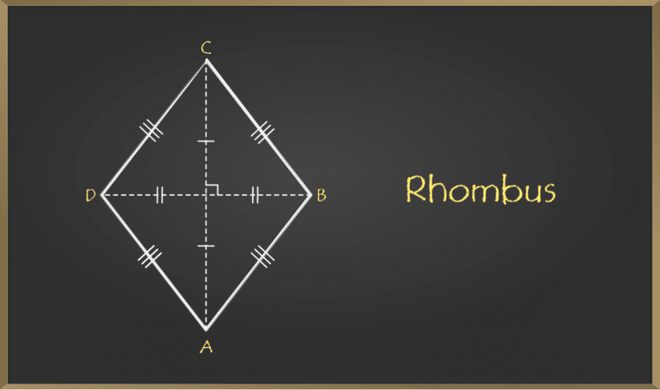
Rhombus
A quadrilateral that has all sides equal and opposite sides parallel is called Rhombus. Opposite angles of a rhombus are equal, and diagonals of the Rhombus bisect each other perpendicularly. Note all rhombus are parallelograms, but the reverse of this is not true.
All 4 sides of a rhombus are equal. AB = BC = CD = AD.
The opposite sides of a rhombus are parallel and equal. In the image above, AB is parallel to CD and AD is parallel to BC.
The diagonals of a rhombus Bisect each other at 90°.
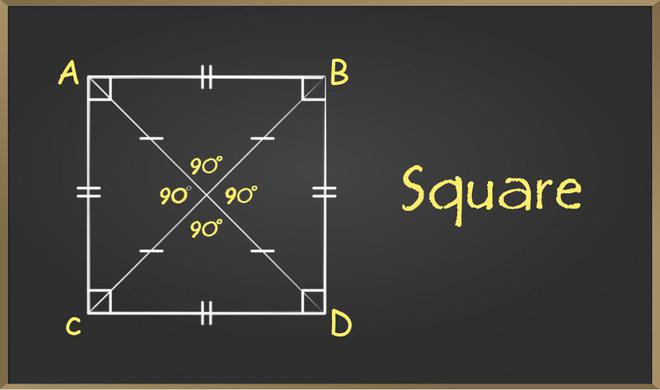
Square
A quadrilateral that has all sides equal and opposite sides parallel and all interior angles equal to 90° is called a Square. Diagonals of squares bisect each other perpendicularly. Note that all squares are rhombus but not vice-versa.
All four sides of a square are equal to each other.
The interior angles of a square are 90°.
The diagonal of a square bisect each other at 90°.
The opposite sides are parallel, and the adjacent sides are perpendicular in a square.
Area of Quadrilaterals
The area of a quadrilateral is defined as the amount of space covered by a quadrilateral in a two-dimensional space. The different types of quadrilaterals have different formulae for their respective area. Below given table shows the formula for the area of each type of quadrilateral:
Perimeter of Quadrilaterals
The perimeter of a quadrilateral is the sum of all its sides. For different quadrilateral shapes, the perimeter formula is different as they portray different characteristics. Below are the formulas for different quadrilateral shapes.
The two diagonals of a convex quadrilateral are the line segments that connect opposite vertices.
The two bimedians of a convex quadrilateral are the line segments that connect the midpoints of opposite sides.[12] They intersect at the "vertex centroid" of the quadrilateral (see § Remarkable points and lines in a convex quadrilateral below).
The four maltitudes of a convex quadrilateral are the perpendiculars to a side—through the midpoint of the opposite side
The area can be expressed in trigonometric terms as[14]
where the lengths of the diagonals are p and q and the angle between them is θ.[15] In the case of an orthodiagonal quadrilateral (e.g. rhombus, square, and kite), this formula reduces to since θ is 90°.
The area can be also expressed in terms of bimedians as[16]
where the lengths of the bimedians are m and n and the angle between them is φ.
where the sides in sequence are a, b, c, d, where s is the semiperimeter, and A and C are two (in fact, any two) opposite angles. This reduces to Brahmagupta's formula for the area of a cyclic quadrilateral—when A + C = 180°.
Another area formula in terms of the sides and angles, with angle C being between sides b and c, and A being between sides a and d, is
In the case of a cyclic quadrilateral, the latter formula becomes
In a parallelogram, where both pairs of opposite sides and angles are equal, this formula reduces to
Alternatively, we can write the area in terms of the sides and the intersection angle θ of the diagonals, as long θ is not 90°:[18]
In the case of a parallelogram, the latter formula becomes
Another area formula including the sides a, b, c, d is[16]
where x is the distance between the midpoints of the diagonals, and φ is the angle between the bimedians.
The last trigonometric area formula including the sides a, b, c, d and the angle α (between a and b) is:[19]
which can also be used for the area of a concave quadrilateral (having the concave part opposite to angle α), by just changing the first sign + to -.
In fact, any three of the four values m, n, p, and q suffice for determination of the area, since in any quadrilateral the four values are related by [24]: p. 126 The corresponding expressions are:[25]
if the lengths of two bimedians and one diagonal are given, and[25]
if the lengths of two diagonals and one bimedian are given.
The area of a quadrilateral ABCD can be calculated using vectors. Let vectors AC and BD form the diagonals from A to C and from B to D. The area of the quadrilateral is then
which is half the magnitude of the cross product of vectors AC and BD. In two-dimensional Euclidean space, expressing vector AC as a free vector in Cartesian space equal to (x1,y1) and BD as (x2,y2), this can be rewritten as:
The lengths of the diagonals in a convex quadrilateral ABCD can be calculated using the law of cosines on each triangle formed by one diagonal and two sides of the quadrilateral. Thus
and
Other, more symmetric formulas for the lengths of the diagonals, are[27]
and
Generalizations of the parallelogram law and Ptolemy's theorem[edit]
In any convex quadrilateral ABCD, the sum of the squares of the four sides is equal to the sum of the squares of the two diagonals plus four times the square of the line segment connecting the midpoints of the diagonals. Thus
The German mathematician Carl Anton Bretschneider derived in 1842 the following generalization of Ptolemy's theorem, regarding the product of the diagonals in a convex quadrilateral[28]
This relation can be considered to be a law of cosines for a quadrilateral. In a cyclic quadrilateral, where A + C = 180°, it reduces to pq = ac + bd. Since cos (A + C) ≥ −1, it also gives a proof of Ptolemy's inequality.
If X and Y are the feet of the normals from B and D to the diagonal AC = p in a convex quadrilateral ABCD with sides a = AB, b = BC, c = CD, d = DA, then[29]: p.14
In a convex quadrilateral ABCD with sides a = AB, b = BC, c = CD, d = DA, and where the diagonals intersect at E,
The shape and size of a convex quadrilateral are fully determined by the lengths of its sides in sequence and of one diagonal between two specified vertices. The two diagonals p, q and the four side lengths a, b, c, d of a quadrilateral are related[14] by the Cayley-Mengerdeterminant, as follows:
The bimedians of a quadrilateral are the line segments connecting the midpoints of the opposite sides. The intersection of the bimedians is the centroid of the vertices of the quadrilateral.[14]
The midpoints of the sides of any quadrilateral (convex, concave or crossed) are the vertices of a parallelogram called the Varignon parallelogram. It has the following properties:
Each pair of opposite sides of the Varignon parallelogram are parallel to a diagonal in the original quadrilateral.
A side of the Varignon parallelogram is half as long as the diagonal in the original quadrilateral it is parallel to.
The area of the Varignon parallelogram equals half the area of the original quadrilateral. This is true in convex, concave and crossed quadrilaterals provided the area of the latter is defined to be the difference of the areas of the two triangles it is composed of.[32]
The perimeter of the Varignon parallelogram equals the sum of the diagonals of the original quadrilateral.
The diagonals of the Varignon parallelogram are the bimedians of the original quadrilateral.
The two bimedians in a quadrilateral and the line segment joining the midpoints of the diagonals in that quadrilateral are concurrent and are all bisected by their point of intersection.[24]: p.125
In a convex quadrilateral with sides a, b, c and d, the length of the bimedian that connects the midpoints of the sides a and c is
where p and q are the length of the diagonals.[33] The length of the bimedian that connects the midpoints of the sides b and d is
The lengths of the bimedians can also be expressed in terms of two opposite sides and the distance x between the midpoints of the diagonals. This is possible when using Euler's quadrilateral theorem in the above formulas. Whence[23]
and
Note that the two opposite sides in these formulas are not the two that the bimedian connects.
In a convex quadrilateral, there is the following dual connection between the bimedians and the diagonals:[29]
with equality if and only if the quadrilateral is cyclic or degenerate such that one side is equal to the sum of the other three (it has collapsed into a line segment, so the area is zero).
The area of any quadrilateral also satisfies the inequality[38]
Among all quadrilaterals with a given perimeter, the one with the largest area is the square. This is called the isoperimetric theorem for quadrilaterals. It is a direct consequence of the area inequality[38]: p.114
where K is the area of a convex quadrilateral with perimeter L. Equality holds if and only if the quadrilateral is a square. The dual theorem states that of all quadrilaterals with a given area, the square has the shortest perimeter.
Of all convex quadrilaterals with given diagonals, the orthodiagonal quadrilateral has the largest area.[38]: p.119 This is a direct consequence of the fact that the area of a convex quadrilateral satisfies
where θ is the angle between the diagonals p and q. Equality holds if and only if θ = 90°.
If P is an interior point in a convex quadrilateral ABCD, then
From this inequality it follows that the point inside a quadrilateral that minimizes the sum of distances to the vertices is the intersection of the diagonals. Hence that point is the Fermat point of a convex quadrilateral.[44]: p.120
Remarkable points and lines in a convex quadrilateral[edit]
The centre of a quadrilateral can be defined in several different ways. The "vertex centroid" comes from considering the quadrilateral as being empty but having equal masses at its vertices. The "side centroid" comes from considering the sides to have constant mass per unit length. The usual centre, called just centroid (centre of area) comes from considering the surface of the quadrilateral as having constant density. These three points are in general not all the same point.[45]
The "vertex centroid" is the intersection of the two bimedians.[46] As with any polygon, the x and y coordinates of the vertex centroid are the arithmetic means of the x and y coordinates of the vertices.
The "area centroid" of quadrilateral ABCD can be constructed in the following way. Let Ga, Gb, Gc, Gd be the centroids of triangles BCD, ACD, ABD, ABC respectively. Then the "area centroid" is the intersection of the lines GaGc and GbGd.[47]
In a general convex quadrilateral ABCD, there are no natural analogies to the circumcenter and orthocenter of a triangle. But two such points can be constructed in the following way. Let Oa, Ob, Oc, Od be the circumcenters of triangles BCD, ACD, ABD, ABC respectively; and denote by Ha, Hb, Hc, Hd the orthocenters in the same triangles. Then the intersection of the lines OaOc and ObOd is called the quasicircumcenter, and the intersection of the lines HaHc and HbHd is called the quasiorthocenter of the convex quadrilateral.[47] These points can be used to define an Euler line of a quadrilateral. In a convex quadrilateral, the quasiorthocenter H, the "area centroid" G, and the quasicircumcenter O are collinear in this order, and HG = 2GO.[47]
There can also be defined a quasinine-point centerE as the intersection of the lines EaEc and EbEd, where Ea, Eb, Ec, Ed are the nine-point centers of triangles BCD, ACD, ABD, ABC respectively. Then E is the midpoint of OH.[47]
Another remarkable line in a convex non-parallelogram quadrilateral is the Newton line, which connects the midpoints of the diagonals, the segment connecting these points being bisected by the vertex centroid. One more interesting line (in some sense dual to the Newton's one) is the line connecting the point of intersection of diagonals with the vertex centroid. The line is remarkable by the fact that it contains the (area) centroid. The vertex centroid divides the segment connecting the intersection of diagonals and the (area) centroid in the ratio 3:1.[48]
For any quadrilateral ABCD with points P and Q the intersections of AD and BC and AB and CD, respectively, the circles (PAB), (PCD), (QAD), and (QBC) pass through a common point M, called a Miquel point.[49]
For a convex quadrilateral ABCD in which E is the point of intersection of the diagonals and F is the point of intersection of the extensions of sides BC and AD, let ω be a circle through E and F which meets CB internally at M and DA internally at N. Let CA meet ω again at L and let DB meet ω again at K. Then there holds: the straight lines NK and ML intersect at point P that is located on the side AB; the straight lines NL and KM intersect at point Q that is located on the side CD. Points P and Q are called "Pascal points" formed by circle ω on sides AB and CD. [50][51][52]
Let exterior squares be drawn on all sides of a quadrilateral. The segments connecting the centers of opposite squares are (a) equal in length, and (b) perpendicular. Thus these centers are the vertices of an orthodiagonal quadrilateral. This is called Van Aubel's theorem.
For any simple quadrilateral with given edge lengths, there is a cyclic quadrilateral with the same edge lengths.[43]
The four smaller triangles formed by the diagonals and sides of a convex quadrilateral have the property that the product of the areas of two opposite triangles equals the product of the areas of the other two triangles.[53]
A taxonomy of quadrilaterals, using a Hasse diagram.
A hierarchical taxonomy of quadrilaterals is illustrated by the figure to the right. Lower classes are special cases of higher classes they are connected to. Note that "trapezoid" here is referring to the North American definition (the British equivalent is a trapezium). Inclusive definitions are used throughout.
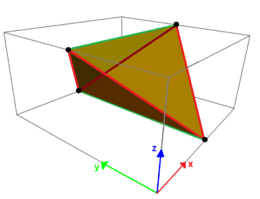
The (red) side edges of tetragonal disphenoid represent a regular zig-zag skew quadrilateral
A non-planar quadrilateral is called a skew quadrilateral. Formulas to compute its dihedral angles from the edge lengths and the angle between two adjacent edges were derived for work on the properties of molecules such as cyclobutane that contain a "puckered" ring of four atoms.[54] Historically the term gauche quadrilateral was also used to mean a skew quadrilateral.[55] A skew quadrilateral together with its diagonals form a (possibly non-regular) tetrahedron, and conversely every skew quadrilateral comes from a tetrahedron where a pair of opposite edges is removed.
Properties of the quadrilaterals – An overview
The diagram given below shows a quadrilateral ABCD and the sum of its internal angles. All the internal angles sum up to 360°. Thus, ∠A + ∠B + ∠C + ∠D = 360°
Properties of quadrilaterals
Rectangle
Square
Parallelogram
Rhombus
Trapezium
All Sides are equal
No
Yes
No
Yes
No
Opposite Sides are equal
Yes
Yes
Yes
Yes
No
Opposite Sides are parallel
Yes
Yes
Yes
Yes
Yes
All angles are equal
Yes
Yes
No
No
No
Opposite angles are equal
Yes
Yes
Yes
Yes
No
Sum of two adjacent angles is 180
Yes
Yes
Yes
Yes
No
Bisect each other
Yes
Yes
Yes
Yes
No
Bisect perpendicularly
No
Yes
No
Yes
No
Let’s discuss each of these 5 quadrilaterals in detail:
Rectangle
A rectangle is a quadrilateral with four right angles. Thus, all the angles in a rectangle are equal (360°/4 = 90°). Moreover, the opposite sides of a rectangle are parallel and equal, and diagonals bisect each other.
Here are the three properties of a rectangle:
All the angles of a rectangle are 90°
Opposite sides of a rectangle are equal and Parallel
Diagonals of a rectangle bisect each other
Rectangle formula – area and perimeter of a rectangle
If the length of the rectangle is L and breadth is B then,
Area of a rectangle = Length × Breadth or L × B
Perimeter of rectangle = 2 × (L + B)
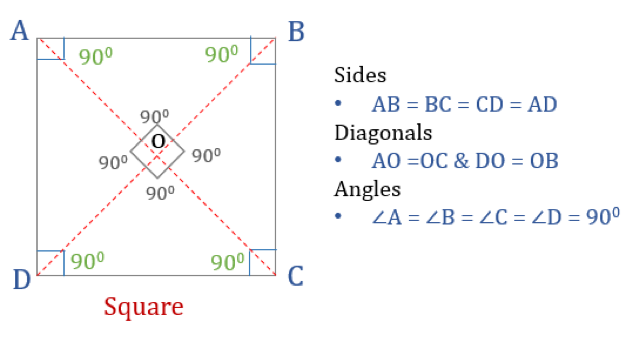
Square | Properties of Quadrilaterals
Square is a quadrilateral with four equal sides and angles. It’s also a regular quadrilateral as both its sides and angles are equal. Just like a rectangle, a square has four angles of 90° each. It can also be seen as a rectangle whose two adjacent sides are equal.
Here are the three properties of a Square:
All the angles of a square are 90°
All sides of a square are equal and parallel to each other
Diagonals bisect each other perpendicularly
Square formula – area and perimeter of a square
If the side of a square is ‘a’ then,
Area of the square = a × a = a²
Perimeter of the square = 2 × (a + a) = 4a
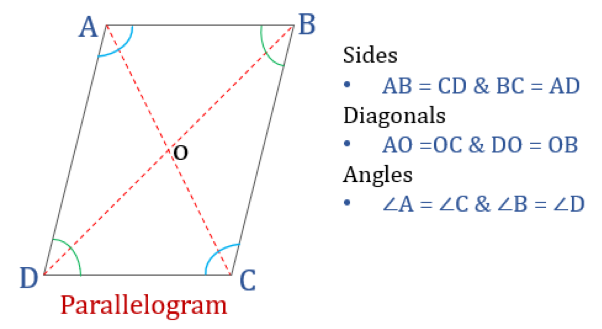
Parallelogram | Properties of Quadrilaterals
A parallelogram, as the name suggests, is a simple quadrilateral whose opposite sides are parallel. Thus, it has two pairs of parallel sides. Moreover, the opposite angles in a parallelogram are equal and their diagonals bisect each other.
Here are the four properties of a Parallelogram:
Opposite angles are equal
Opposite sides are equal and parallel
Diagonals bisect each other
Sum of any two adjacent angles is 180°
Parallelogram formulas – area and perimeter of a parallelogram
If the length of a parallelogram is ‘l’, breadth is ‘b’ and height is ‘h’ then:
Perimeter of parallelogram= 2 × (l + b)
Area of the parallelogram = l × h
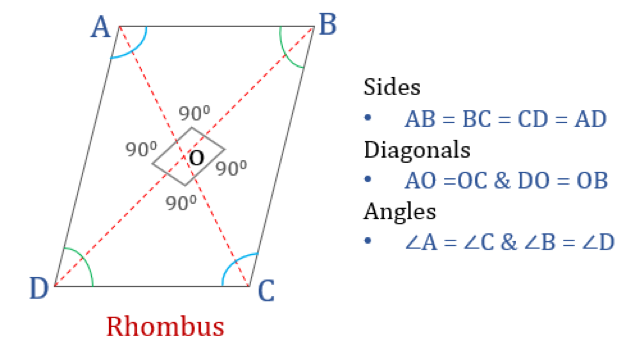
Rhombus
A rhombus is a quadrilateral whose all four sides are equal in length and opposite sides are parallel to each other. However, the angles are not equal to 90°. A rhombus with right angles would become a square. Another name for rhombus is ‘diamond’ as it looks similar to the diamond suit in playing cards.
Here are the four properties of a Rhombus:
Opposite angles are equal
All sides are equal and, opposite sides are parallel to each other
Diagonals bisect each other perpendicularly
Sum of any two adjacent angles is 180°
Rhombus formulas – area and perimeter of a rhombus
If the side of a rhombus is a then, perimeter of a rhombus = 4a
If the length of two diagonals of the rhombus is d1 and d2 then the area of a rhombus = ½ × d1 × d2
Trapezium
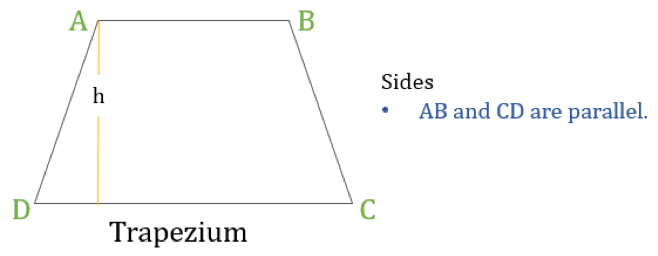
A trapezium (called Trapezoid in the US) is a quadrilateral that has only one pair of parallel sides. The parallel sides are referred to as ‘bases’ and the other two sides are called ‘legs’ or lateral sides.
A trapezium is a quadrilateral in which the following one property:
Only one pair of opposite sides are parallel to each other
Trapezium formulas – area and perimeter of a trapezium
If the height of a trapezium is ‘h’ (as shown in the above diagram) then:
Perimeter of the trapezium= Sum of lengths of all the sides = AB + BC + CD + DA
Area of the trapezium = ½ × (Sum of lengths of parallel sides) × h = ½ × (AB + CD) × h
Properties of Quadrilaterals – Summary
The below image also summarizes the properties of quadrilaterals
Important Facts of Quadrilateral
A quadrilateral is a trapezoid or a trapezium if 2 of its sides are parallel to each other.
A quadrilateral is a parallelogram if 2 pairs of sides parallel to each other.
Squares and Rectangles are special types of parallelograms. Below are some special properties.– All internal angles are of “right angle” (90 degrees).– Each figure contains 4 right angles.– Sides of a square are of the same length (all sides are congruent) – Opposite sides of a rectangle are the same.– Opposite sides of a rectangle and square are parallel.
A quadrilateral is a rhombus, if
All the sides are of equal length-specified 2 pairs of sides are parallel to each other.
A kite is a special sort of quadrilateral, in which 2 pairs of adjacent sides are equal to each other.
Quadrilaterals Solved Examples
Example 1: What is the base of a rhombus, if its area is 40 square units and the height is 8 units? Solution: Given, Area = 40 square units Height = 8 units Area of rhombus = Base × Height 40 = Base × 8 Base = 40/8 = 5 units
Example 2: If 15 metres and 6 metres are diagonal lengths of a kite, then what is its area?
Solution: Given, diagonal 1 = 15 metre and diagonal 2 = 6 metre. So, the area is simply calculated as, (1/2)(15×6) = 45 m2.
Example 3: Find the perimeter of the quadrilateral with sides 5 cm, 7 cm, 9 cm and 11 cm.
Solution: Given, sides of a quadrilateral are 5 cm, 7 cm, 9 cm and 11 cm.
Therefore, perimeter of quadrilateral is:
P = 5 cm + 7 cm + 9 cm + 11 cm = 32 cm
Example 4: The perimeter of the quadrilateral is 50 cm and the lengths of the three sides are 9 cm, 13 cm and 17 cm. Find the missing side of the quadrilateral.
Solution: Let the unknown side of the quadrilateral = x
Given, Perimeter of the quadrilateral = 50 cm
The lengths of other three sides are 9 cm, 13 cm and 17 cm
As we know,
Perimeter = sum of all the four sides.
50 = 9 cm + 13 cm + 17 cm + x
50 = 39 + x
x = 50 – 39
x = 11
Therefore, the fourth side of quadrilateral = 11 cm
Example 5. Find the missing angle in the given quadrilateral.
Solution:
We know that the sum of all the angles of a quadrilateral is 360°.
Hence, we can write it as follows:
x + 77° + 101° + 67 = 360°
x + 245° = 360°
x = 360° – 245°
Therefore, x = 115°
Example 6: What will be the perimeter of a quadrilateral with sides 6 cm, 8 cm, 10 cm, and 12 cm?
Solution:
Given, the sides of a quadrilateral are 6 cm, 8 cm, 10 cm, and 12 cm.
Therefore, perimeter of quadrilateral is:
P = 6 cm + 8 cm + 10 cm + 12 cm = 36 cm
Example 7: If the area of a rhombus is 60 square units and its height is 6 units, what will be the value of its base?
Solution:
In the above example, it is given that –
Area of the Rhombus = 60 square units
Height of the Rhombus = 6 units
Area of rhombus = Base x Height
60 = Base x 6
Base = 60/6 = 10 units
Example 8: The perimeter of quadrilateral ABCD is 46 units. AB = x + 7, BC = 2x + 3, CD = 3x – 8, and DA = 4x – 6. Find the length of the shortest side of the quadrilateral.
Solution:
Perimeter = Sum of all sides
= 46 = 10x – 4 or [x = 5]
That gives, AB = 12 units, BC = 13 units, CD = 7 units, DC = 14 units
Hence length of shortest side is 7 units (i.e. CD).
Example 9: Given a trapezoid ABCD (AB || DC) with median EF. AB = 3x – 5, CD = 2x -1 and EF = 2x + 1. Find the value of EF.
Solution:
We know that the Median of the trapezoid is half the sum of its bases.
= EF = (AB + CD) / 2
= 4x + 2 = 5x – 6 or [x = 8]
Therefore EF = 2x + 1 = 2(8) + 1 => EF = 17 units.
Example 10: In a Parallelogram, adjacent angles are in the ratio of 1:2. Find the measures of all angles of this Parallelogram.
Solution:
Let the adjacent angle be x and 2x.
We know that in of a Parallelogram adjacent angles are supplementary.
= x + 2x = 180° or [x = 60°]
Also, opposite angles are equal in a Parallelogram.
Therefore measures of each angles are 60°, 120°, 60°, 120°.
Example 11: Perimeter of a rhombus is 52 units, and the length of one of its diagonal is 24 units. Find the length of another diagonal.
Solution:
Given: Perimeter = 52 unit.
Length of diagonal (say AC) = 24 Units.
We know that, rhombus has its all four sides equal.
= AB + BC + CD + DA = 52.
= 4(AB) = 52 = AB = 13 units.
Also, diagonals of Rhombus bisects each other perpendicularly. Hence in given picture AE = EC and BE = ED and ∠AEB = 90°.
Applying Pythagoras theorem in ∆AEB,(∠AEB = 90°)
= (AB)2 = (AE)2 + (EB)2
= (13)2 = (12)2 + (EB)2
= (EB)2 = 169 – 144 = 25
= EB = 5 units.
Since, AC = 2 × EB = 10 units.
Therefore, requiredlength of another diagonal of rhombus is 10 units..
Conclusion
This article has taught us that a quadrilateral is a closed-shape polygon with four sides, four angles, and four verticals. In SplashLearn, your child can learn about quadrilaterals in a fun and gaming way. This easy and unique method of learning quickly grabs the attention of young learners. Therefore, parents and teachers can teach quadrilaterals to their children without much effort.








Comments
Post a Comment